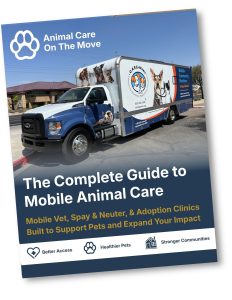
The mobile veterinary clinics that best support teaching hospitals’ field training are those that let faculty supervise the planned clinical work, give students defined roles, and maintain a practical animal-care workflow at the intended sites. Compare dimensioned layouts with the actual teaching team and equipment. Magnum’s configurable veterinary and spay/neuter platforms provide different workspaces to evaluate against that brief.
A teaching clinic has two connected purposes: providing appropriate care and supporting supervised learning. A floor plan that works for an experienced small team may need a different review when learners rotate through examinations, procedures, documentation, and recovery support. Begin with the teaching activity rather than a target student headcount.
What Should a Veterinary Teaching Vehicle Allow Faculty to Do?
Ask faculty to walk through each planned activity and identify where the instructor, student, animal, assistant, and equipment must be. Review access from more than one side of a table where required, sightlines, circulation, and the ability to intervene without blocking another task.
Separate staff working positions from observers. A bench, room count, or marketing staff range is not a validated teaching capacity. Determine the practical working arrangement through your institution’s clinical and safety review of the selected layout.
Field learning is an established part of some veterinary education programs. For example, Cornell’s SOS/Cornell Student Teaching Program describes outreach collaboration intended to build students’ clinical and surgical experience. That is educational context, not a claim that Cornell uses or endorses a particular Magnum vehicle.
On a small screen, swipe the table sideways to see every column.
| Teaching activity | Layout or system question | Who should review |
|---|---|---|
| Supervised examination | Where can the student work and the instructor observe or assist without blocking circulation? | Clinical faculty / design team |
| Procedure preparation | Where are selected equipment, supplies, work surfaces, and connections located? | Faculty / equipment suppliers |
| Surgical teaching, if planned | Does the proposed space support the approved team roles and faculty access? | Clinical leadership |
| Recovery and holding | How will the institution’s approved holding, observation, and recovery workflow fit? | Clinical team |
| Records and feedback | Where can learners document care and receive feedback without interrupting patient flow? | Faculty / operations / IT |
| Setup and closing | Which vehicle tasks belong to trained operators, and which learning activities are permitted? | Fleet / program leadership |
Match the Vehicle to the Type of Field Training
Define whether the rotation focuses on wellness examinations, preventive services, shelter medicine, surgical care, or a combination. Then identify the equipment, patient flow, and faculty involvement needed for the approved services.
- Examination-focused outreach: review handling space, exam-table access, storage, records, and the position of the supervising clinician.
- Procedure-focused teaching: review the specified preparation, procedure, equipment, and recovery workspaces as a connected workflow.
- Mixed rotations: explain how services or teaching groups will be scheduled so the same space is not assigned to conflicting activities.
Use a faculty-approved equipment list before finalizing the floor plan. Device sizes, connections, service clearances, and securing for travel can affect where people can safely work.
Which Magnum Platforms Can a Veterinary School Evaluate?
On a small screen, swipe the table sideways to see every column.
| Platform | Published workspace starting point | Teaching question |
|---|---|---|
| 19ft Mobile Veterinary Clinic | Compact Ford Transit platform with an open exam/treatment area. | Does a small supervised working group fit the selected activity and actual circulation space? |
| 26ft Mobile Veterinary Clinic | Ford E-450 platform with an exam/treatment area, separate surgery suite, and storage. | How will faculty and learners move between the planned workspaces and animal-care tasks? |
| Spay and Neuter Clinic Range | Trailer and drivable configurations with preparation, surgery, and recovery-related spaces. | Which configuration supports the institution’s approved procedural teaching workflow? |
These vehicles are options to assess, not pre-approved classrooms. Confirm the final equipment, work positions, animal holding, utility systems, and site fit with Magnum and your institution. Do not convert vehicle room counts into student capacity or promise a number of teaching cases from the layout alone.
Keep Animal Flow and Learner Movement in the Same Plan
Trace the patient path from arrival and identification through the planned examination or procedure, holding or recovery where applicable, and discharge. Then trace where students and faculty move at each stage. Identify places where observers, carriers, supplies, or documentation tasks could crowd the clinical workspace.
Have the clinical team define its animal handling, cleaning, instrument workflow, and other care requirements. The builder can incorporate the specified physical needs into the proposed vehicle; clinical decisions remain with the institution and its qualified professionals.
Our intake, treatment, and recovery space guide provides additional vehicle-planning questions. Review any exterior support area with the host rather than assuming that a waiting or teaching space will always be available outside.
Plan the Field Site, Transport, and Documentation Setup
A good teaching layout still needs a workable deployment. Review the approach, parking, entry clearances, utilities, team facilities, weather plan, and communication arrangements at each partner site. Include the whole operating footprint and any tow vehicle.
Separate travel from teaching occupancy. Review approved travel seating, restraints, passenger arrangements, and driver requirements with the institution’s fleet team. Floor space for a learning activity does not establish how many people may travel in the vehicle.
For documentation, ask the institution’s IT team to define approved devices, connectivity, charging, records access, and privacy requirements. Confirm that any planned screens or devices can be mounted and powered appropriately in the selected configuration.
Test the Teaching Layout Before Approving It
Use a structured floor-plan review with faculty, clinical staff, fleet, facilities, purchasing, and IT representatives as relevant. Walk through one realistic case from setup to closing, including where learners rotate and how feedback is given.
Illustrative scenario, not a customer case study: a veterinary teaching team plans community wellness visits with faculty supervising one student’s examination while another completes records. The team reviews table access, supply reach, documentation space, and the next animal’s holding arrangement. If the space is crowded, it changes the rotation plan or compares a different configuration before approving the build.
Use our floor-plan review guide to record decisions and unresolved questions. Confirm selected equipment and owner responsibilities with the proposal.
Why Bring the Teaching Brief to Magnum?
Magnum’s configurable layouts let the discussion start with your clinical and educational workflow. Its veterinary range gives faculty concrete platform and workspace choices, supported by commercial-grade construction and integrated vehicle systems.
Ask Magnum to explain the layout tradeoffs, equipment scope, utilities, and handoff for the proposed vehicle. Bring the people who will teach, operate, and maintain it into the conversation so the build reflects the complete program.
Mobile Veterinary Teaching Clinic FAQs
How many students can work in a mobile veterinary clinic?
The answer depends on the selected floor plan, activity, equipment, clinical team, and faculty access. Determine a practical working group through the institution’s review. Staff ranges and room counts do not establish student capacity.
Can a compact veterinary clinic support field teaching?
It can be evaluated for a defined activity and small supervised working group. Review actual table access, instructor position, equipment, animal handling, and documentation space before deciding that it fits the rotation.
Does a veterinary teaching program need a surgery suite?
That depends on its approved services and learning objectives. An examination-focused program and a surgical rotation have different workspace and equipment requirements. The clinical faculty should define those requirements before vehicle selection.
Does the vehicle make the program accredited or clinically compliant?
No vehicle purchase establishes accreditation or approval for a program. The institution must resolve applicable educational, clinical, professional, and operating requirements through its own responsible teams.
What should a veterinary school send Magnum first?
Send the proposed learning activities, services, faculty and learner roles, equipment list, animal-flow plan, partner sites, transport arrangements, and target timeline. Include institutional requirements and open decisions that need a layout review.
Plan Your Veterinary Teaching Vehicle With Magnum
Discuss a mobile veterinary teaching vehicle with Magnum and request a configuration review based on your faculty-approved brief. Explore the mobile veterinary clinic range and request the free Mobile Animal Care Buyer Guide for broader purchasing preparation.
Vehicle details reviewed November 10, 2026 against the linked Magnum product pages. The educational program reference is provided for context and does not imply an endorsement or customer relationship.